
1980-1984
1980-1984
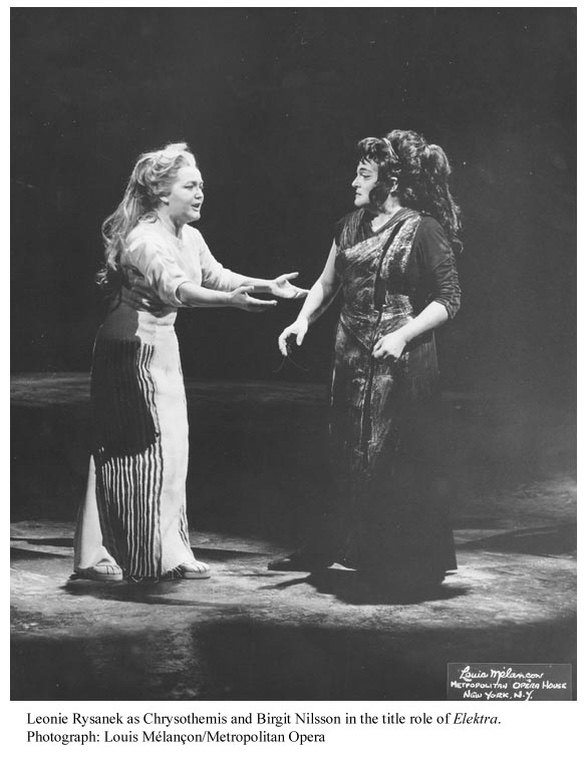
Vendredi 1 février 1980 : Elektra. Metropolitan Opera New York. Levine. Birgit Nilsson (Elektra). Rysanek. Dunn. McIntyre. Cassilly.
Review by Irving Kolodin in Newsday:
NILSSON BECOMES ELEKTRA
As post-performance comments have mentioned, the audience that filled every inch of the Metropolitan Opera's legal capacity paid its supreme tribute to Birgit Nilsson on her return there Friday night, after five years' absence, in Richard Strauss's "Elektra." It was, to a man (and woman) on its feet at the end, but hardly anyone moved toward an exit.
Contrary to all customs of social procedure that prevail in New York at present, no one cared about getting a car out of the parking garage, or finding a cab on a cold February night. What the audience had seen and heard was sufficiently uncommon to transcend all else.
It was an extraordinary fulfillment by Nilsson of a nearly 30-year international career which extended from Electra to Elektra. The latter was the title role of the opera which had just ended. But Electra? Where is that to be found? It is, of course, a prominent role in Mozart's "Idomeneo," in which Nilsson had made her first stage appearance outside of her native Sweden, at England's Glyndebourne Festival of 1951.
As the lady herself has been known to say, when a young colleague's next role has been mentioned: "Don't forget she's doing the Electra that's spelled with a 'c' not a 'k'." In her own case, as Electra with a 'c,' Nilsson had a raw abundance of voice, unrefined by artistry. It would be an exaggeration to say that, 30 years later, the balance has been shifted from one side to the other. But it is no exaggeration to say that very few singers of any recent time have preserved so long, so much of what they had to work with in their youth.
Lurking in the background of a Sunday column in Newsday some months ago, when her forthcoming return was first announced, were a pair of questions:
"Is she risking the high degree of esteem she earned [since her Met debut in 1959] by starting a new decade of operatic activity when most performers have packed it all in?
"Is it wise? Only she knows.
Those who have been hearing her over the long road from Electra to Elektra have, along the way, acquired a fair degree of conviction that Nilsson is not an artist given to rash or impulsive acts, professionally. She gave up singing Senta in Wagner's "Flying Dutchman" (despite the pleas of operatic managers, here and abroad) because she didn't believe the part was for her. And you will search in vain for a performance of the same composer's "Parsifal" with Nilsson as Kundry for the same reason.
The Met concert of last November in which she sang superbly in excerpts from operas by Wagner and Strauss answered a share of the uncertainty. Yes, she had quantity, and quality, of voice. But, let it not be forgotten, a concert with a Wagner orchestra behind the voice is one thing; an opera performance with a Strauss orchestra between the singer and the audience is quite another.
Foremost among those who had not forgotten it was Nilsson herself. At the outset of her first "Elektra" in New York in nine years, as the central Figure in a story of fratricide and murder, projecting the healthy hatred of a daughter (Elektra) for a mother (Klytemnestra) who had killed the husband-father (Agememnon) in his bath, her rough sounding, oddly unmusical intonation was affected by two things. First is the nature of Strauss's writing, which is hardly bel canto. The second was the plain evidence that she was, in a plain phrase, scared to death. Her breath was short, her heart very likely overbeating under the stress of circumstances.
It took 15 minutes before she cast off the first tremors. By the time a half-hour had passed, and she had been joined by the marvellously sympathetic Leonie Rysanek, as her sister-in-action, Chrysothemis, she was into the flow of it. And when the hour had passed which brings the famously ugly scene between Elektra and her debauched mother (played by Mignon Dunn), Nilsson was not merely in the stream of it, but dominating the action (as Strauss intended).
Meteorologically speaking, the state of the Nilsson voice in her first "Elektra" could be described as "Partly cloudy, with sunny interludes." But the essence of her success with the public was the nucleus of art which enabled her to get the most from it, to control the quietly reflective passages as well as the chillingly dramatic ones, and to be able to evoke the sunshine in her sound when it was the most necessary.
This came in the celebrated "Recognition" scene, when her long-lost brother Orestes (convincingly performed by Donald McIntyre) reappears to fulfill his appointed task of leading the assault on the palace, and his mother, and to reward her paramour Aegesthis (with Richard Cassilly as an uncommonly good specimen of the breed) with the lethal thrust he had well-earned. Finally, in the summarizing "Agememnon!" in which Strauss allows Elektra to echo in triumph what she had pronounced in pleading at the evening's beginning, Nilsson was celebrating not only her character's triumph over difficulties, but her own.
Of the supporting cast, which included John Cheek in a brief but memorable impersonation of the Old Guardian, the least supportive was conductor James Levine, who chose to associate his first direction of the Strauss score anywhere, with the historic return of Nilsson. Most of the evening he spent with his head in the score, and his energetic efforts directed at the orchestra, leaving much of the action on stage, and the cues thereto, in the hands of the prompter.
This "Elektra" will not be seen on television during the present sequence of performances. But will be audibly available on the broadcast of Feb. 16. I think the vocal sun will be shining brightly between 2 and 3:45 that afternoon.
Mercredi 6 février 1980 : Elektra. Metropolitan Opera New York. Levine. Birgit Nilsson (Elektra). Rysanek. Dunn. McIntyre. Cassilly.
Mardi 12 février 1980 : Elektra. Metropolitan Opera New York. Levine. Birgit Nilsson (Elektra). Rysanek. Dunn. McIntyre. Nagy.
Review of Patrick J. Smith in Opera (UK)
Birgit Nilsson's four performances of "Elektra - her first appearances in opera at the Metropolitan Opera since 1975 and her tax difficulties - had been sold out since last autumn, and the frenzied acclamations after the performance I heard on February 12 went on far into the night. It was a deserving tribute to a great artist, and I wish I could have more wholeheartedly shared the enthusiasm. Nilsson remains a considerable singer and stage presence, and if the voice is now smaller, whiter and more apt to stray from pitch, she brings to Electra a constant attention to word and drama. Yet, finally, it is a distanced reading of that tortured role, a series of calculations rather than a matter of spontaneity. Her Electra is a regal, aloof matron and not a creature possessed, and if the sarcasm and banked fires are made evident, one is never aware of the monomania that inevitably results in exhaustion and death.
The cast surrounding her was a strong one, but one not subject to anything but the most cursory directorial control (Paul Mills was listed as producer). Leonie Rysanek's familiar, wildly anguished virgin (she has an amazing amount of voice left in her throat) was well contrasted with Mignon Dunn's underplayed Clytemnestra; although Miss Dunn sounded in far more steady vocal shape than she did earlier in the season as Ortrud, she sang the role rather than emoted it. James Levine opted for a broad, lyrical reading of the score, at its best in moments like the oily depiction of Clytemnestra at her entrance. Yet the reading came perilously close, in places, to slackness, particularly just before and during the recognition of Orestes. I never felt an intensity or the cumulative power of the score.
A share of the evening's dissipation of punch must be credited (or debited) to the fact that it was a run-through for a television taping. and thus, as the programme delicately put it, "light levels have been adjusted." Adjusted indeed - put up to full candlepower would be more accurate, so that the gloom and mystery that are innate were dispelled, so that the deficiencies of Rudolf Heinrich's set were painstakingly revealed as they never should be, and so that the evocative projections on the overhanging clouds - an integral part of the "turn of the screw" - were invisible. The culmination came with Electra's lighting the way for Aegisthus to enter the palace: laughable, since it took place on a fully lit stage. I would like to say that the paying audience was being shortchanged by these outside television demands, except that most of the audience prefers bright light to any sort of dramatic stage lighting, but certainly it would seem that, if the Met chooses to employ a director of production, as John Dexter is listed as being, one of his jobs should be putting a stop to the deliberate falsification of not only a concept but the ambience of the opera itself. But it seems as if the television Moloch has become, at the Met as elsewhere, too powerful to be gainsaid by mere directors.
Samedi 16 février 1980 : Elektra. Metropolitan Opera New York. Levine. Birgit Nilsson (Elektra). Rysanek. Dunn. McIntyre. Nagy.
Mardi 25 mars 1980 : Elektra. Opera royal de Stockholm. Segerstam. Ericson. Birgit Nilsson (Elektra). Andersson. Hoiseth. Jupither.
Dimanche 13 avril 1980 : Die Frau ohne Schatten. Staatsoper Vienne. Stein. King. Rysanek. Dernesch. Wimberger. Berry. Birgit Nilsson (Femme de Barak)
Lundi 12 mai 1980 : Elektra. Munich Nationaltheater. Birgit Nilsson (Elektra)
Samedi 5 juillet 1980 : Récital Birgit Nilsson. Monaco (Salle Garnier)
Vendredi 8 août 1980 : Stora Scenen, Groena Lund, Stockholm.
Mercredi 10 septembre 1980 : Die Frau ohne Schatten. Opera de San Francisco. Klobucar. Hesse. Herincx. King. Rysanek. Feldhoff. Birgit Nilsson (femme de Barak)
Lundi 15 septembre 1980 : Die Frau ohne Schatten. Opera de San Francisco. Klobucar. Hesse. Herincx. King. Rysanek. Feldhoff. Birgit Nilsson (femme de Barak)
Samedi 20 septembre 1980 : Die Frau ohne Schatten. Opera de San Francisco. Klobucar. Hesse. Herincx. King. Rysanek. Feldhoff. Birgit Nilsson (femme de Barak)
Jeudi 25 septembre 1980 : Die Frau ohne Schatten. Opera de San Francisco. Klobucar. Hesse. Herincx. King. Rysanek. Feldhoff. Birgit Nilsson (femme de Barak)
Mardi 30 septembre 1980 : Die Frau ohne Schatten. Opera de San Francisco. Klobucar. Hesse. Herincx. King. Marton. Feldhoff. Birgit Nilsson (femme de Barak)
Dimanche 19 octobre 1980 : Elektra. Staatsoper Vienne. Klobucar. Hoffman. Birgit Nilsson (Elektra). Rysanek. King. Feldhoff.
Jeudi 23 octobre 1980 : Elektra. Staatsoper Vienne. Klobucar. Hoffman. Birgit Nilsson (Elektra). Rysanek. King. Feldhoff.
Lundi 27 octobre 1980 : Elektra. Staatsoper Vienne. Klobucar. Hoffman. Birgit Nilsson (Elektra). Rysanek. Beirer. Feldhoff.
Mercredi 19 novembre 1980 : Elektra. Munich Nationaltheater. Birgit Nilsson (Elektra)
1980-1984
1981
Samedi 14 février 1981 : Die Walkure. Opéra royal de Stockholm. Ehrling. Eliasson. Wahlund. Arvidson. Af Malmborg. Birgit Nilsson (Brunnhilde). Ericson.
Samedi 11 avril 1981 : Wagner Concert Metropolitan de New York. Acte 2 (Parsifal) : Levine. Vickers. Dunn. Cheek. Robinson. Wohlafka. Volkman. Norden. Di Franco. Jones. Love duett (Tristan und Isolde) : Levine. Birgit Nilsson. Vickers. Dunn.
Dimanche 12 avril 1981 : Wagner Concert Metropolitan de New York. Levine. Prélude acte 1 - Die Meistersinger von Nurnberg. Duo de l’ acte 3 - Die Walkure (Birgit Nilsson. Estes). Dawn, Zu neuen Taten (Jung. Birgit Nilsson ), Rhine journey - Die Gotterdammerung. Prélude et Liebestod - Tristan und Isolde (Birgit Nilsson ).
Review of Alan Rich in New York Magazine
MAKING THEMSELVES YOUTHFUL
Even so, nothing in its shortened, disease-racked season became the Met like the leaving of it. There was the young Malfitano and there was the just-as-young Birgit Nilsson - not the hastily arranged Saturday-broadcast matinee. but the full glory of the Sunday-night Wagner concert. On that night of nights you didn't just hear a veteran star singer doing all right for 63. The thrust and majesty of almost all her singing belonged to the annals of Nilsson's own glory over two decades at the Met. When had she made those last lines of Brünnhilde's last entreaty to Wotan more beguiling than now? When had her exhortations to the loving Siegfried rung out more heroically?
True, there were some problems, but few of them belonged to the sovereign singer we had come to greet and cheer. James Levine conducted, and he has still to learn that fast Wagner does not automatically gladden hearts in the same way as does fast Puccini. Up on the Met's stage, the orchestra sounded as harsh and unbalanced now as it had in the [first]-night Mahler, except that I had forgiven it then on the strength of the preceding long hiatus. Simon Estes sang an eloquent Wotan in the "Walküre" scene, but could not be heard for long stretches. It remains to be seen (no, heard) whether he can manage this repertory in a house this large. Manfred Jung, the new heldentenor. looks and acts as goofy as the last several interpretors, sang a Siegfried with very little ring in it, but would probably make a fine Lohengrin.
All of this is niggle-naggle, of course, against the duality of Nilsson's work and what it tells us about her current estate. She is down to sing the Dyer's Wife in next season's "Frau ohne Schatten." I saw her do it last year in San Francisco, and it was an astounding performance, not merely as a vocal achievement, but as the best realization of the vulgar passion in this role that I ever expect to see.
Dimanche 3 mai 1981 : Die Frau ohne Schatten. Staatsoper Vienne. Prick. Schunk. Hass. Hesse. Wimberger. Berry. Birgit Nilsson (femme de Barak).
Jeudi 18 juin 1981 : Die Frau ohne Schatten. Staatsoper Vienne. Stein. King. Rysanek. Hesse. Wimberger. Adam. Birgit Nilsson (femme de Barak).
Dimanche 5 juillet 1981 : Concert. Arena sferisterio di Macerata. Herbert Kegel. Birgit Nilsson. Orchestre symphonique de Dresde.
Jeudi 3 septembre 1981 : Concert Helsinki. Segerstam. Birgit Nilsson. Matti Salminen.
Mardi 8 septembre 1981 : BBC PROMS. Londres. Stephen Portman / Birgit Nilsson. Symphonie 8 (Schubert). Zueignung, Morgen, Caecilie (Richard Strauss). Barak, Mein Mann (Die Frau ohne Schatten). Symphonie 3 (Sibelius). Prélude et mort d’ Isolde (Tristan und Isolde)
Lundi 12 octobre 1981 : Die Frau ohne Schatten. Metropolitan Opera New York. Leinsdorf. Marton. Brenneis. Birgit Nilsson (Femme de Barak). Nentwig. Dunn. Mazura.
Review of Peter G. Davis in New York Magazine
THAT OLD MET MAGIC
"...Most people came to cheer the return of Nilsson in Die Frau ohne Schatten; in Eva Marton they found a new star..."
"At last the Met has managed to stir up a little excitement!" an elderly lady exclaimed-nay, shouted-above the din, as the curtain fell on the Metropolitan Opera's first "Die Frau ohne Schatten" of the season. Originally planned as a showcase for Birgit Nilsson, the evening turned into something better-a great night at the opera.
First of all, there was the potent attraction of the opera itself. Lofty in tone and spectacular in its scenic and vocal requirements, the Strauss-von Hofmannsthal work is inexhaustibly inventive, colorful, and moving, a festival event whenever it is staged, no matter what the quality of the performance. The Met's production, one of the company's glories over the past fifteen years, avoids italicizing the opera's already heavy symbolic content, instead conjuring up an exotic fairy-tale atmosphere.
Robert O'Hearn's glistening sets seem to take on a life all their own as they appear from above and below, recede, move forward, dissipate into the air only to reassemble again, always in a way that enhances, complements, and clarifies the involved plot. The Emperor and Empress move through a spirit world of dazzling beauty, a series of fantastic stage pictures whose cool, blue-greet oceanographic decor contrasts startlingly with the sun-baked reality of the drab hut inhabited by their earthly counterparts, the dyer Barak and his wife. Nathaniel Merrill directs the singers through these complex designs sensibly and smoothly, stressing human conflicts but never obscuring the opera's otherworldly vision or impeding its dramatic flow. With a work of such baroque complexity, no production will be perfect in every particular, but this one aims high and achieves much.
Most people came to cheer Birgit Nilsson as the Dyer's Wife, a role she had never before sung at the Met. Once regarded merely as a phenomenon of nature, Nilsson at 63 is now held in awe as a geriatric miracle. Most singers her age prolong their careers by making discreet adjustments in repertory to accommodate declining vocal resources. Not Nilsson. The Dyer's Wife is a killing assignment that keeps a soprano trumpeting at the top of her lungs for most of the evening.
Yes, there were rocky moments. Passages at peak volume in the upper register are no longer effortlessly sustained, and under stress the tone is apt to degenerate into a piercing siren-wail. No matter, Nilsson still gets over the major hurdles honorably, and for most of the time she is recognizably the same brilliantly clarion singer she has always been-honest, unstinting, and direct, with an astonishingly durable vocal musculature that one day must surely be left to science. True, there were few shades of detail in either her singing or her acting-interpretive niceties have never been a facet of this artist's healthy, no-nonsense temperament and head-on approach. The majority of Nilsson's admirers over the years have gladly done without the subtleties and simply basked in the sound of her voice, understandably so in these lean times.
The surprise of the evening was Eva Marton as the Empress. Her stratospheric role has been the property of the indestructible Leonie Rysanek for the past quarter century, but Marton gave no one cause to regret the substitution. In contrast to the Dyer's Wife, the dignified Empress expresses her agonizing dilemma in purely vocal terms, a tortured lyricism at a pitch of fevered intensity. It is essentially a stand-and-deliver role, and while Marton's measured singing may have seemed a trifle placid compared to Rysanek's whiplash phrasing, the Hungarian soprano unflinchingly rose to every challenge, often with thrilling results. She hurled forth one ravishingly beautiful note after another with incomparable power, security, and total sheen, capping it all with a stunning high D-flat in her dream sequence. At the end, Nilsson received the respect due an old favorite, but Marton was greeted with the tumultuous approval of an audience that had unexpectedly discovered a star.
As the malevolent Nurse, Mignon Dunn cut an unusually giddy figure, but she handily matched Nilsson and Marton when it came to sheer volume. Franz Ferdinand Nentwig as Barak and Gerd Brenneis as the Emperor tended to pale alongside this high-powered trio, although both gave highly creditable and sympathetic performances. After his deadly conducting of the two Ring operas earlier this season, Erich Leinsdorf partially redeemed himself with a crystalline presentation of Strauss's luxuriant score.Review of Joan Hanauer, United Press International :Sopranos come and go at New York's Metropolitan Opera but Monday night's performance of Richard Strauss's 'Die Frau ohne Schatten' was memorable for the performances of veteran Wagnerian Birgit Nilsson and a relative newcomer, Hungarian Eva Marton. Miss Nilsson, 63, marking her 35th year in opera, sang the role of the Dyer's Wife with amazing power and security and won several delirious ovations.It's supposed to be her last new role at the Met. Beautiful Miss Marton made it her evening, too, singing the Empress brilliantly and turning in an acting performance of authority and grace that drew cheers from the audience. It's the only role she's scheduled for at the Met this season but a spokesman said, 'You know, that can change.'
Samedi 17 octobre 1981 : Die Frau ohne Schatten. Metropolitan Opera New York. Leinsdorf. Marton. Brenneis. Birgit Nilsson (Femme de Barak). Nentwig. Dunn. Mazura.
Vendredi 23 octobre 1981 : Die Frau ohne Schatten. Metropolitan Opera New York. Leinsdorf. Marton. Brenneis. Birgit Nilsson (Femme de Barak). Nentwig. Dunn. Mazura.
Jeudi 29 octobre 1981 : Die Frau ohne Schatten. Metropolitan Opera New York. Leinsdorf. Marton. Brenneis. Birgit Nilsson (Femme de Barak). Nentwig. Dunn. Mazura.
Vendredi 20 novembre 1981 : Die Walkure. Opéra de San Francisco. Suitner. King. Rysanek. Rydl. Schenk. Birgit Nilsson (Brunnhilde). Denize.
Mercredi 25 novembre 1981 : Die Walkure. Opéra de San Francisco. Suitner. King. Rysanek. Rydl. Schenk. Birgit Nilsson (Brunnhilde). Denize.
Mardi 1 décembre 1981 : Die Walkure. Opéra de San Francisco. Suitner. King. Rysanek. Rydl. Schenk. Birgit Nilsson (Brunnhilde). Denize.
1980-1984
1982
Mercredi 6 janvier 1982 : Elektra. Munich Nationaltheater. Birgit Nilsson (Elektra)
Vendredi 22 janvier 1982 : Elektra. Staatsoper Vienne. Klobucar. Schlemm. Birgit Nilsson (Elektra). Jones. Beirer. Nentwig.
Vendredi 5 février 1982 : Elektra. Munich Nationaltheater. Birgit Nilsson (Elektra)
Dimanche 9 mai 1982 : Die Frau ohne Schatten. Staatsoper Vienne. Prick. King. Hass. Dernesch. Wimberger. Berry. Birgit Nilsson (femme de Barak)
Mercredi 16 juin 1982 : Elektra. Frankfurt am Main. Birgit Nilsson (Elektra).
1980-1984
1983
Samedi 22 octobre 1983 : The Metropolitan Opera Centennial Gala II (100th anniversary of the Metropolitan Opera). Réalisation : Kirk Browning. USA. Telecast in 2 two-hour segments of consecutive evenings. Bernstein. Levine. Pritchard. Fulton / Caballe. Carreras. Plishka. Giacomini. Merritt. Cheek. Winbergh. Hartman. Cotrubas. Devia. Kraft. Daniels. Tajo. Neblett. Estes. Velis. McNeil. Arroyo. Dunn. Mauro. Elvira. Moffo. Merrill. Meier. Elias. Resnik. Alexander. Macurdy. Hines. Amara. Berini. Bumbry. Bruson. Ricciarelli. Lewis. Ghiaurov. Mitchell. Ciannella. Jenkins. Kesling. Moser. Dubinbaum. Rendall. Darrenkamp. Bruscantini. Berberian. Shicoff. Best. Horne. Birgit Nilsson (Tristan und Isolde : Narrative and curse / Lillijebjorn / Encore : I remember when I was seventeen). Price. Pavarotti.